

When the dragonfly became a jewel
A green leaf with a dragonfly resting on it. Something you might barely notice on a walk received the full attention of jewellery artists in the age of Art Nouveau.
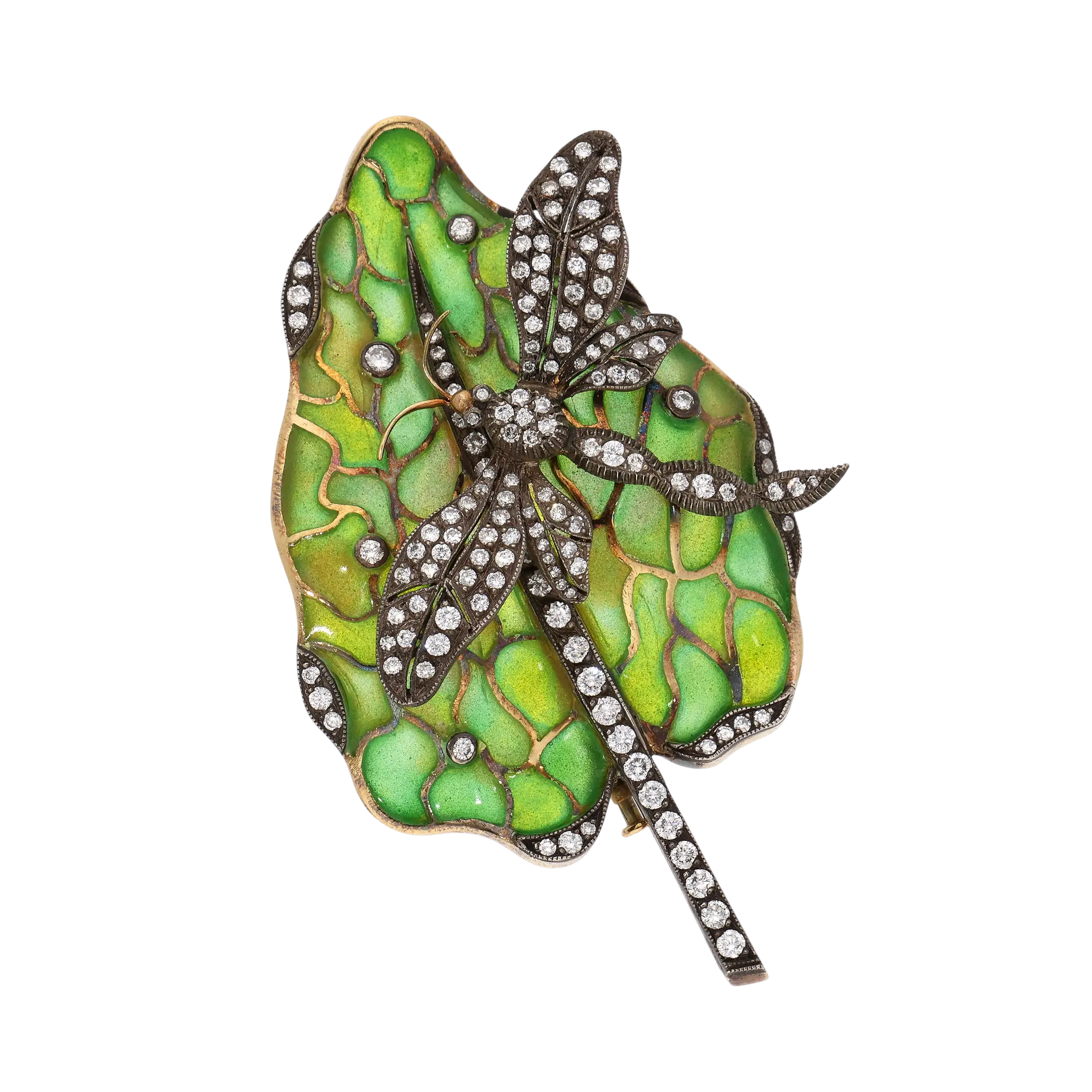
First, you see the diamonds. They cover the four wings and the slender body of the dragonfly – in relief, as if it had only just landed.
Then you discover the leaf beneath: small green fields of enamel, traced through with golden outlines. Single diamonds sit between them like drops of water, and the long stem reaches out beyond the leaf.
The green comes alive
In the catalogue photograph the green looks calm. In our short film we hold the brooch out into the day – and it reveals its full range, from pale yellow to deep emerald. The golden outlines stand out and give the leaf its drawing.
A few seconds that show why this brooch is more than the sum of its diamonds.
Take a closer look
Enamel is a glass-like substance that is fused to the prepared metal by firing. Here it forms mosaic-like fields of colour; the golden outlines between them recall the veins of a leaf.
- Enamel mosaic: set field by field, framed by golden veins.
- Drops of water: single diamonds between the fields – on the leaf approx. 1.5 ct in total.
- Four wings, densely set with diamonds – the dragonfly carries approx. 1 ct in total.
- The stem, set with a row of diamonds, reaches out beyond the leaf.
When nature became the teacher
Around 1900, plants and insects became part of the repertoire of a new art of jewellery. A leaf no longer had to be symmetrical, and an insect could become the centrepiece of a jewel. In France the movement was called Art Nouveau, in the German-speaking world Jugendstil; at the Paris Exposition Universelle of 1900 it made its grand entrance.
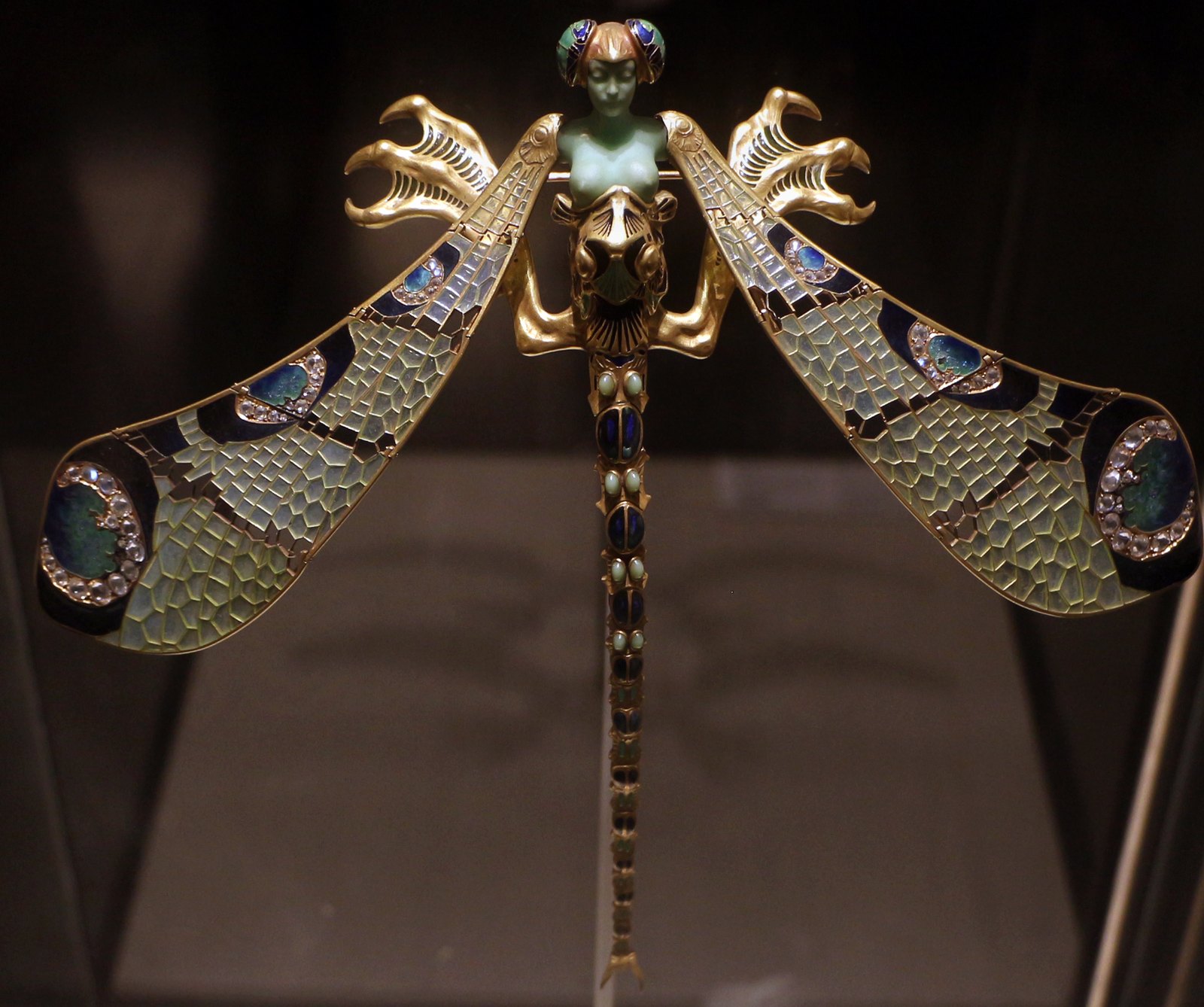
One of its great innovators was René Lalique, who began as a jeweller. His “Dragonfly Woman” of around 1897–1898 unites a female figure with a fantastical insect in gold, enamel and diamonds; Calouste Gulbenkian acquired it in 1903, and today it belongs to his museum in Lisbon.
Our brooch is dated to around 1900 and probably comes from France; its maker is not known. And while the “Dragonfly Woman” is a large showpiece, our dragonfly is made to be worn.

A leaf from behind, too
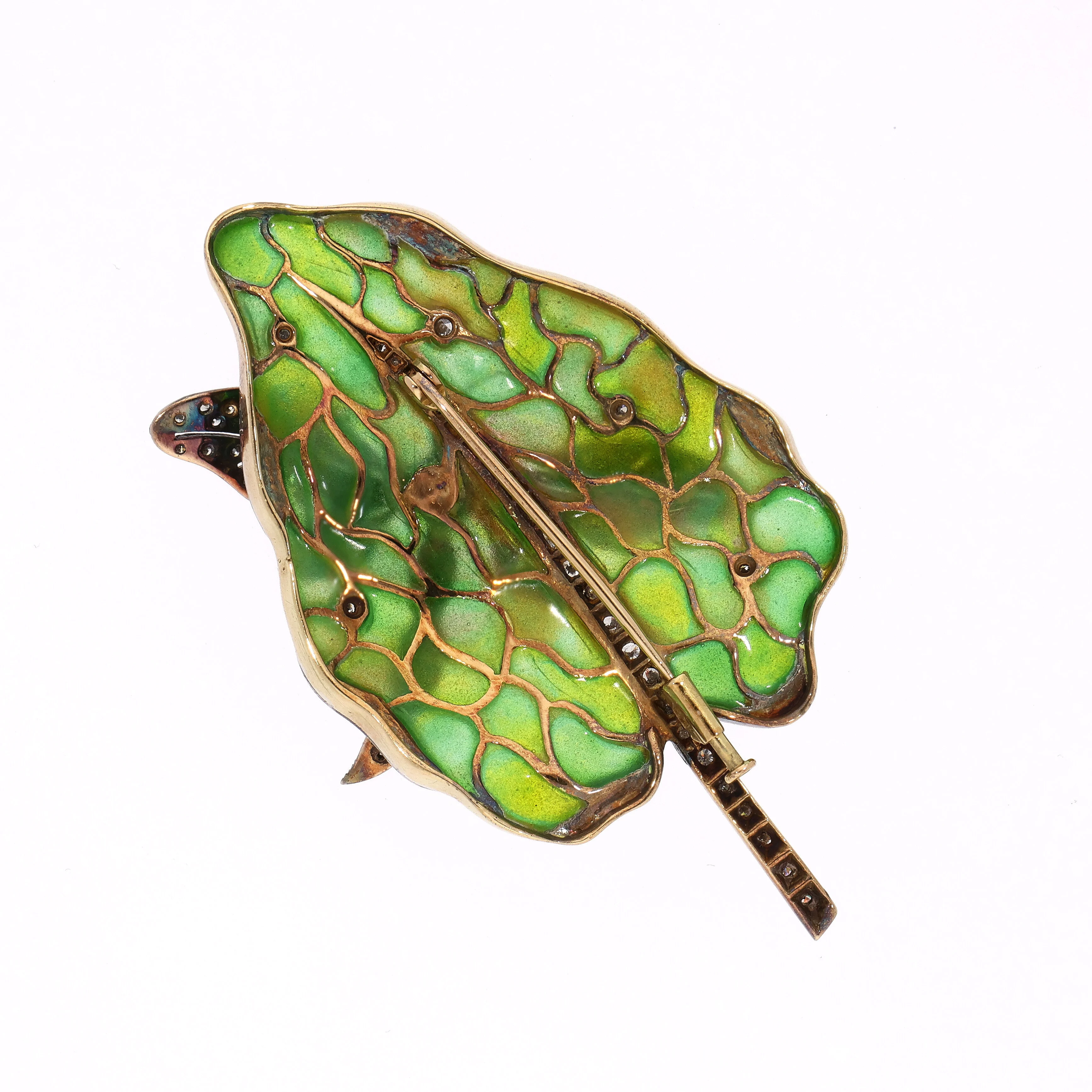
Turn the brooch over and you are in for a surprise: the reverse, too, shows the green mosaic, framed by golden partitions. The pin runs exactly along the stem – the construction hides within the drawing of the leaf.
Only in motion do you see how the dragonfly hovers above the leaf.
Art Nouveau brooch “Dragonfly”
- Date
- circa 1900, probably France
- Material
- 18K yellow gold / silver
- Diamonds, leaf
- approx. 1.5 ct total (H/SI)
- Diamonds, dragonfly
- approx. 1 ct total (I–K/SI)
- Enamel
- green, mosaic-like
- Dimensions
- 7.5 × 4.5 cm
- Weight
- 25.42 g
- Condition
- very fine
On just 7.5 × 4.5 centimetres, a small scene from nature unfolds. A brooch with plenty left to discover once you have looked past the diamonds.
Auktionshaus Rapp · JewelleryThursday, 26 November 2026
from 1.30 pm at Auktionshaus Rapp, Wil SG · Rapp Auction 48 · Lot 2026
View the jewellery catalogue- Calouste Gulbenkian Museum, Lisbon: “Dragonfly Woman”, inv. 1197
- Victoria and Albert Museum, London: Art Nouveau Glass and Jewellery; Champlevé Enamelling
- Musée Lalique, Wingen-sur-Moder: Jewellery
- The Metropolitan Museum of Art, New York: Art Nouveau (Heilbrunn Timeline of Art History)
Photos and videos of the brooch: Auktionshaus Rapp · “Dragonfly Woman”: photo Sailko, CC BY 3.0, via Wikimedia Commons. A comparison of motif and period, not an attribution.
Lot Story: choreography and production by Martin Ohmann Rapp · texts by Marianne Rapp Ohmann & expert team · Auktionshaus Rapp