

A serpent holds a heart
Garnet eyes, a green emerald – and a small heart beneath its mouth.
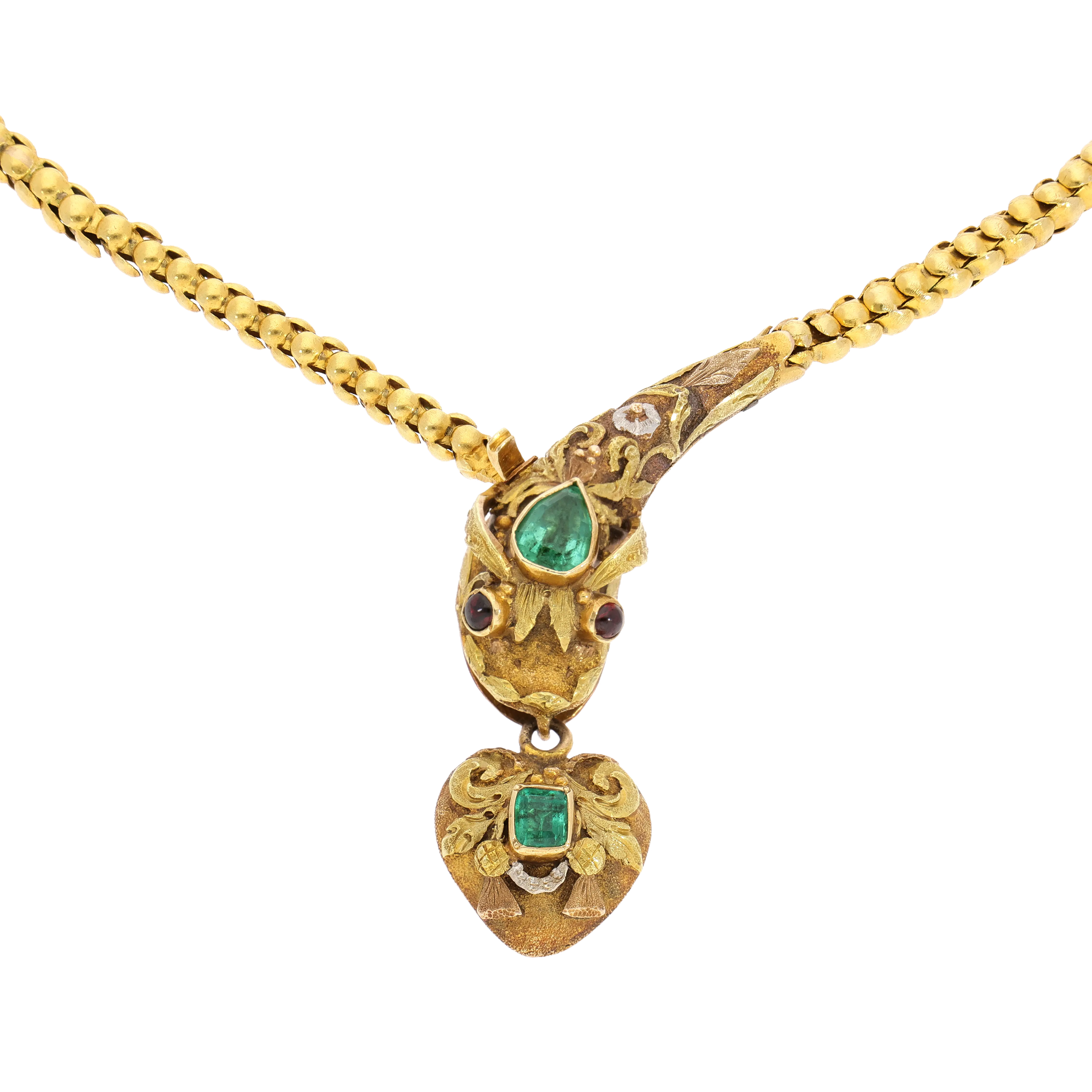
A watchful gaze from garnet eyes, an emerald on the brow. And beneath the mouth, a small gold heart.
This necklace takes us back to a time when a serpent could be one of the loveliest messages of love in jewellery.
A heart at the serpent’s mouth
The heart reveals itself only at second glance. First, the richly decorated head draws the eye. Then the gaze travels down: to the finely engraved scrolls, the small rectangular emerald and the little ring just beneath the mouth.
The serpent seems to carry the heart – an unusual, almost tender scene. Because the pendant hangs freely, the heart has its own small range of movement beside the sculpted head.
When an animal speaks of love
Today, many people think of danger when they see a snake. Nineteenth-century jewellery read it differently. The serpent stood for regeneration and therefore for eternity, as the Victoria and Albert Museum in London explains – which is why it appears on love jewellery.
The heart gave the feeling a familiar shape. Our necklace is not alone in combining the two: an antique jewellery dealer documents a necklace from around 1860 whose serpent likewise has garnet eyes and emeralds – and holds a heart in its mouth. The dealer reads the pairing as an image of eternal love.
No fixed meaning for the heart at the mouth has come down to us, nor has the early history of our necklace. The reading remains an invitation.
A motif with staying power
The fashion did not begin with the young queen – but she gave it a face.
- c. 1820–1840A serpent necklace in gold, enamel, diamonds and rubies, now in the London Museum.London Museum
- 1839Victoria becomes engaged to Albert. Her engagement ring takes the form of a serpent, set with emeralds.V&A · Charlotte Gere
- c. 1860A necklace with garnet eyes, emeralds and a heart in the serpent’s mouth.Comparable piece, trade
- 2nd half 19th c.Our necklace, probably England.Rapp Auction 48
The London Museum notes that the serpent remained popular for necklaces, bracelets, earrings and rings well into the second half of the century.
Two emeralds, two shapes
The larger emerald, pear-shaped and approx. 0.5 ct, sits on the brow. The smaller one in the heart is step-cut, approx. 0.25 ct. Their green leads the eye from the head to the pendant.
The smooth domes of the two garnet cabochons strike a different note from the faceted emeralds. Yellow gold 15K and platinum accents bring warm and cool tones together; the head is sculpted and partly decorated in two colours, the heart finely engraved with scrolls.
At 39 centimetres, the necklace sits close to the neck.
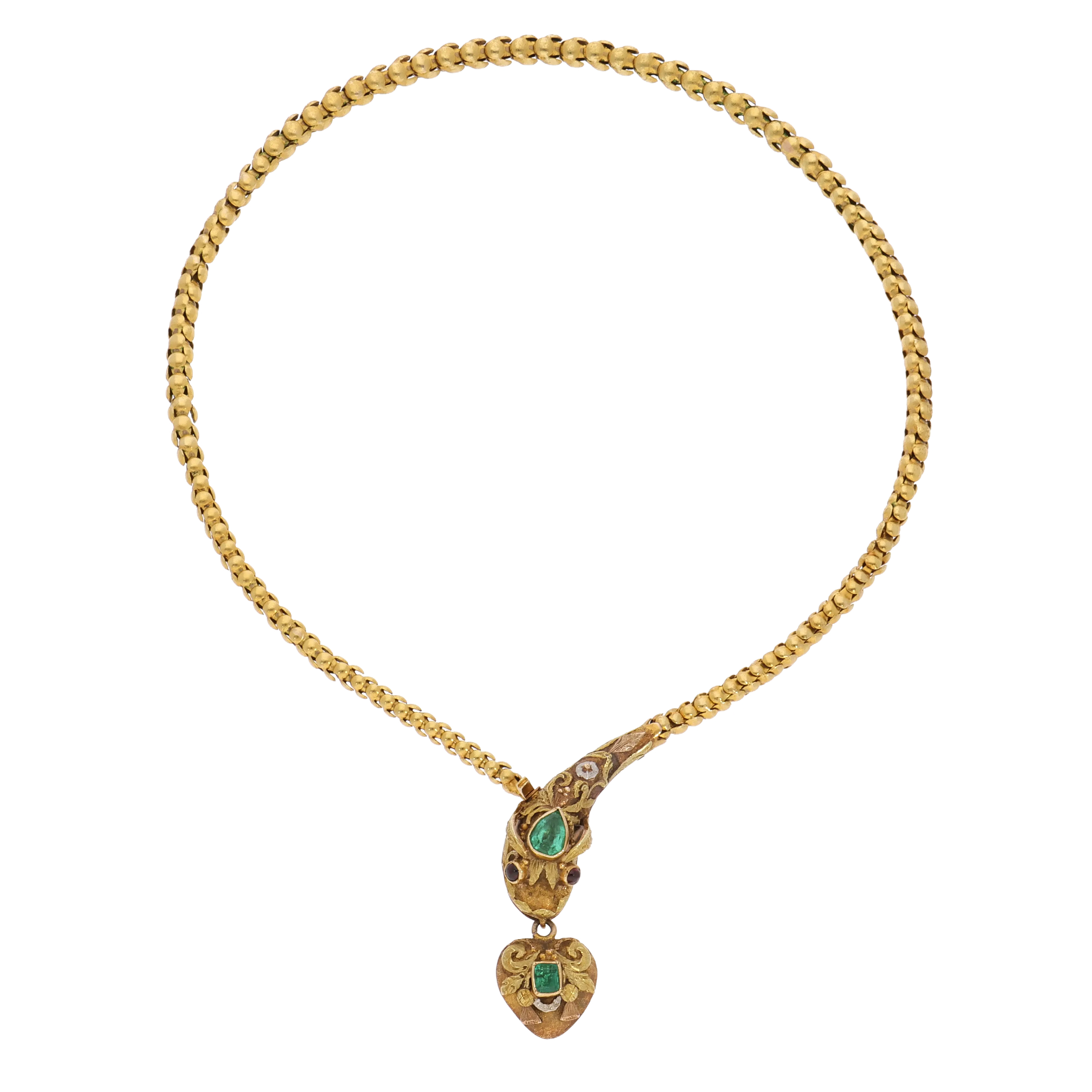
Best seen up close
In the hand you see how small the details are – and how clearly they still speak. The heart moves along with it.
At the neck, the story feels surprisingly present: the gold chain follows the base of the neck, the head sits slightly at an angle, the heart hangs below. A piece with character that reveals more the closer you look.
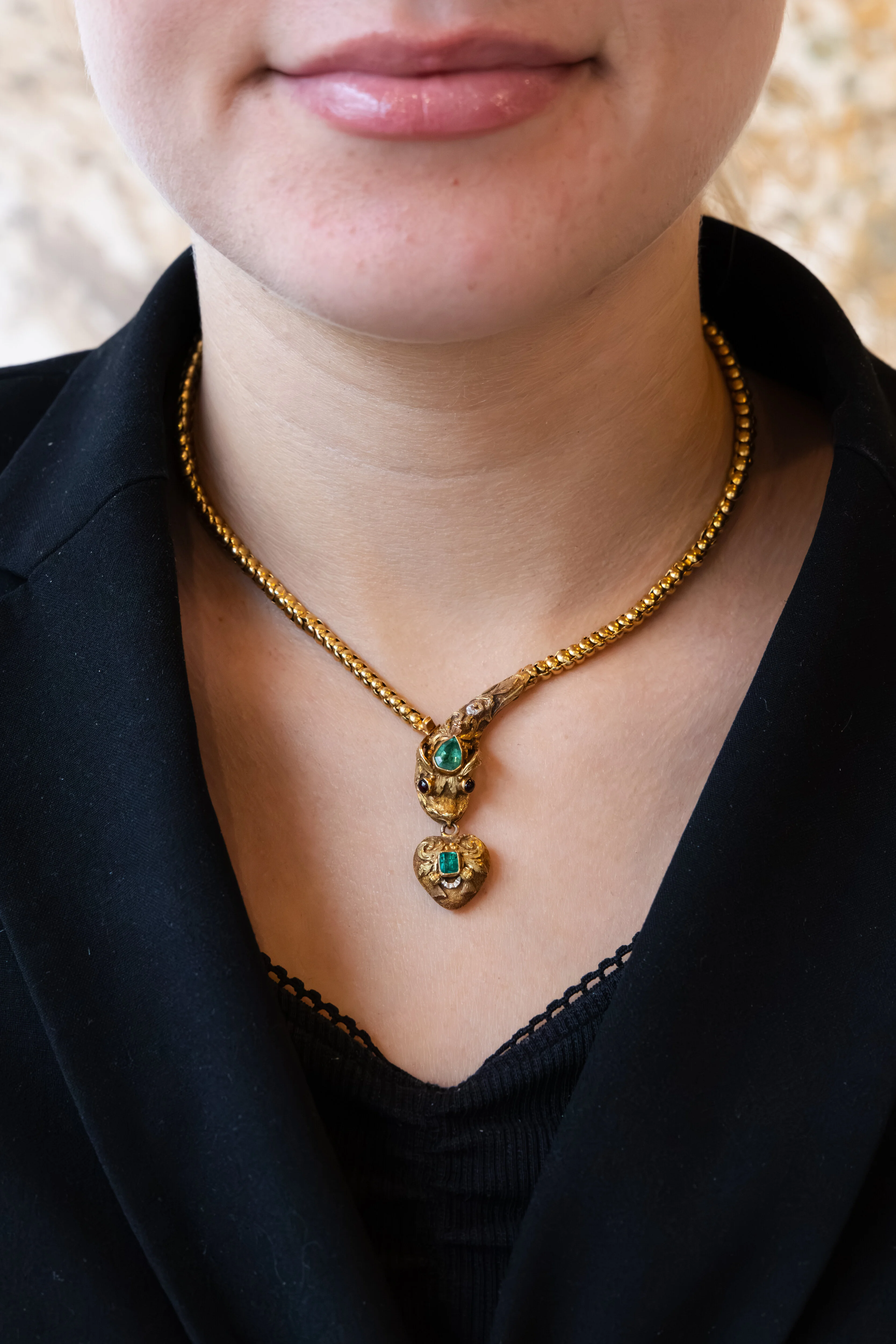
Serpent necklace
- Origin
- Probably England, second half of the 19th century (catalogue statement)
- Metal
- Yellow gold 15K with platinum accents
- Eyes
- Two garnet cabochons, together approx. 0.1 ct
- Brow
- Pear-shaped emerald, approx. 0.5 ct
- Pendant
- Movable heart with finely engraved scrolls
- Heart stone
- Step-cut emerald, approx. 0.25 ct
- Length
- 39 cm
- Weight
- 26.31 g
What we love about this necklace is the moment beneath the serpent’s mouth: a small heart, hanging freely. Once you have seen this pairing, you look at the serpent with different eyes.
Auktionshaus Rapp · JewelleryThursday, 26 November 2026
from 1.30 pm at Auktionshaus Rapp, Wil SG · Rapp Auction 48 · Lot 2030
View the jewellery catalogue- Victoria and Albert Museum: serpent ring, England, 1800–1830 (symbolism, Victoria’s engagement ring)
- London Museum: Necklace, c. 1820–1840, object 33.86/9
- Charlotte Gere: Victorian Jewellery Design (1972), chapter 10, via The Victorian Web
- Erica Weiner: Victorian Snake Necklace with Emeralds (comparable piece, trade)
Photos and video: Auktionshaus Rapp. Origin and dating are catalogue statements. Comparable pieces provide context, not attribution.
Lot Story: choreography and production by Martin Ohmann Rapp · texts by Marianne Rapp Ohmann & expert team · Auktionshaus Rapp