

A second life in gold
An ancient coin image becomes the centrepiece of a Bulgari necklace.
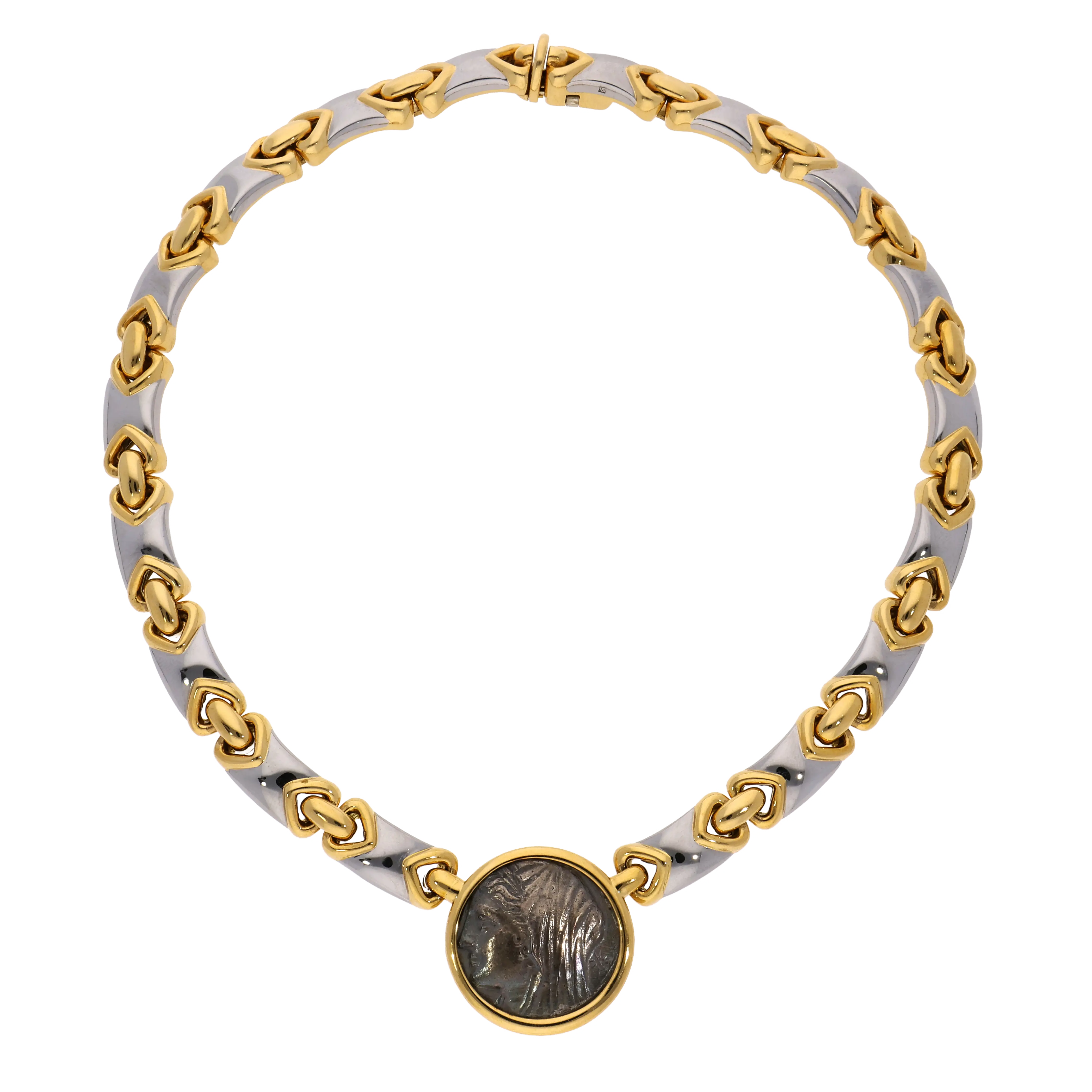
A queen in profile and, on the other side, a four-horse chariot. At the centre of this Bulgari necklace sits an ancient coin from Syracuse, more than 2,200 years old.
Around it: polished yellow and white gold, rounded links and a clear, powerful form. Here, history really can be worn.
Who is looking at us?
A house between Greece and Rome
Sotirio Bulgari, a Greek silversmith, opened his first shop on Via Sistina in Rome in 1884. Alongside his own silver work he offered precious objects and antiques – a feeling for the past belonged to the house from early on.
Bulgari was already setting coins in the 1930s. They became a trademark in the 1960s, when the third generation led the house. Nicola Bulgari, an enthusiastic coin collector, saw small works of art in their portraits and motifs. In 1966 the first coin jewels with Greek and Roman coins were made – the beginning of the Monete line, Italian for “coins”.
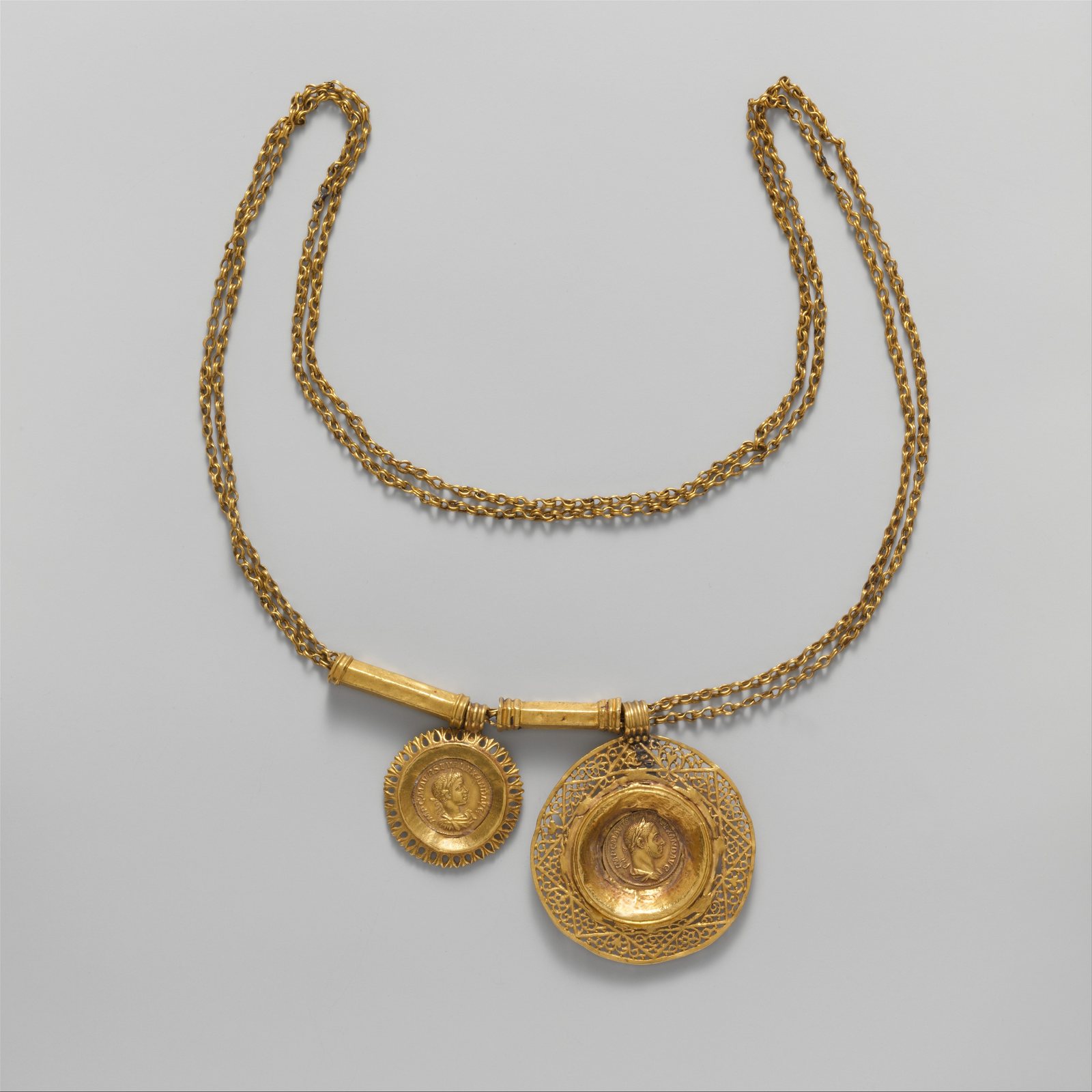
The idea itself was not new: as early as the 3rd century AD, Romans wore gold necklaces with mounted coins.
Warm gold and cool gold
A principle of the line: the mount follows the contour of the coin and preserves its character. The matt, dark surface of the old silver coin stands against smoothly polished gold.
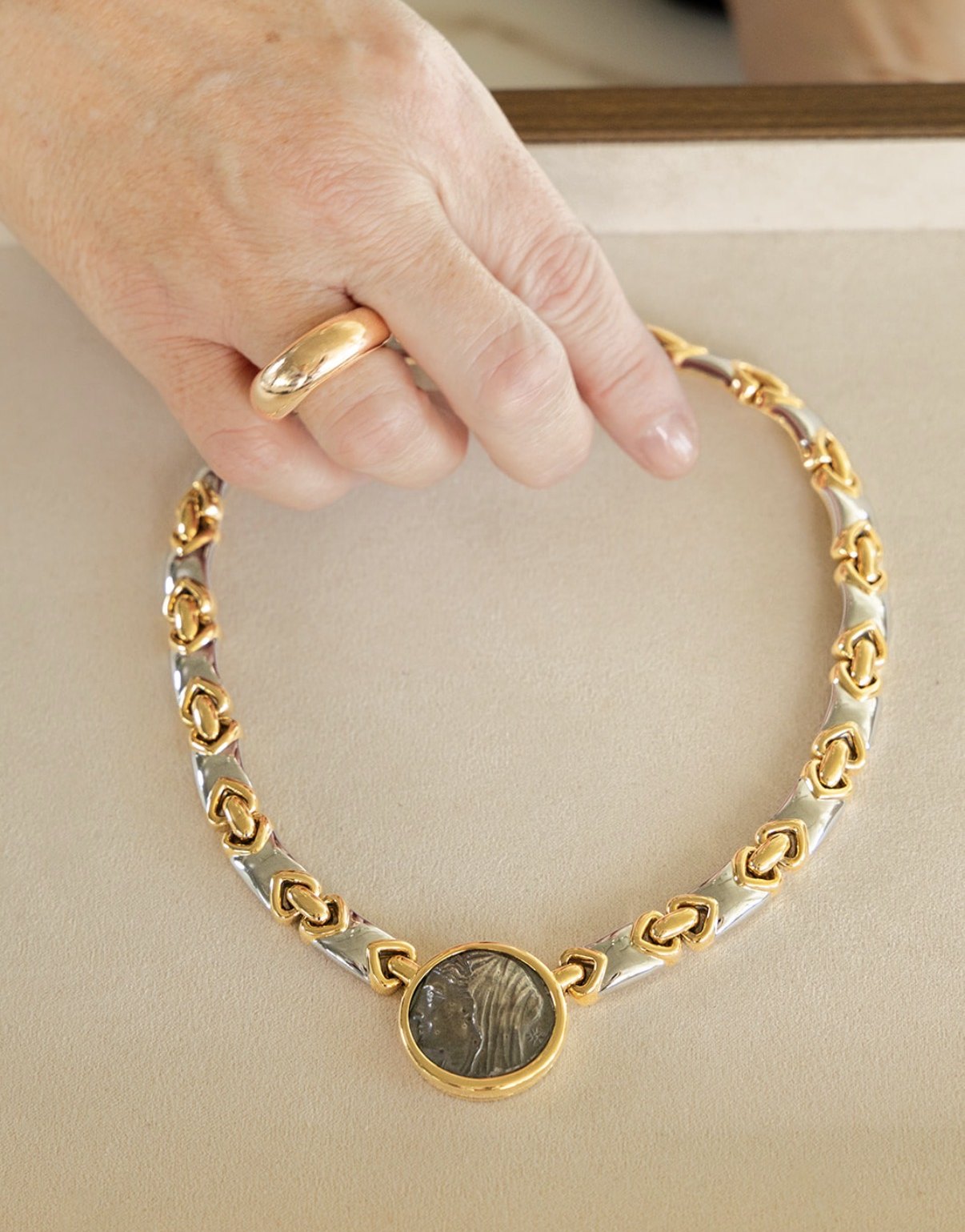
In our necklace, rounded links in white gold alternate with oval connecting elements in yellow gold. The coin rests in a smooth gold bezel; at 39.5 centimetres the necklace sits close to the neck. According to the catalogue, it was probably made around 1980–1990.
- Smooth gold bezel – it follows the round of the coin.
- Oval connecting element in yellow gold.
- Rounded, highly polished link in white gold.
A queen from Syracuse
The coin shows Philistis, wife of Hieron II of Syracuse, wearing a diadem and veil. It was struck in Sicily under Hieron II, who reigned from about 275 to 215 BC: a silver piece of 16 litrai. On the reverse, the quadriga – on this type driven by Nike, goddess of victory.
Her likeness is known to us only from these coins. Our numismatist adds a lovely thought: a coin that honours a woman has become a jewel for a woman. A double tribute.
- Syracuse, Sicily
- Hieron II
- 16 litrai, silver
- c. 275–215 BC
- Philistis · quadriga
Bulgari “Monete”
- Material
- 18K yellow and white gold
- Centre
- Ancient coin in a smooth gold bezel
- Coin
- 16 litrai, Syracuse, struck under Hieron II (c. 275–215 BC); obverse Philistis, reverse quadriga
- Date
- Probably around 1980–1990 (catalogue)
- Length
- 39.5 cm
- Weight
- 167.98 g
- Clasp
- Integrated box clasp
- Accessories
- Bulgari case
A necklace that brings together two of our specialist fields: jewellery and numismatics. A clear presence – and a centrepiece you will want to come a little closer to.
Auktionshaus Rapp · Jewellery and NumismaticsThursday, 26 November 2026
from 1.30 pm at Auktionshaus Rapp, Wil SG · Rapp Auction 48 · Lot 2121
View the jewellery catalogue- Bulgari: History 1884
- Bulgari: History of the 1960s
- National Gallery of Victoria: Bulgari, artwork labels (2016)
- The Metropolitan Museum of Art: Gold necklace with coin pendants, 17.190.1655
- Museum of Fine Arts, Boston: 16 litrai of Syracuse with head of Philistis, struck under Hieron II
- W. Smith, Dictionary of Greek and Roman Biography and Mythology: Philistis
Photos: Auktionshaus Rapp; Roman gold necklace: The Metropolitan Museum of Art, Public Domain. Identification of the coin: numismatics department, Auktionshaus Rapp. The dating of the necklace is a catalogue statement.
Lot Story: choreography and production by Martin Ohmann Rapp · texts by Marianne Rapp Ohmann & expert team · Auktionshaus Rapp